How to Backtest Crypto Trade Calls Before You Act
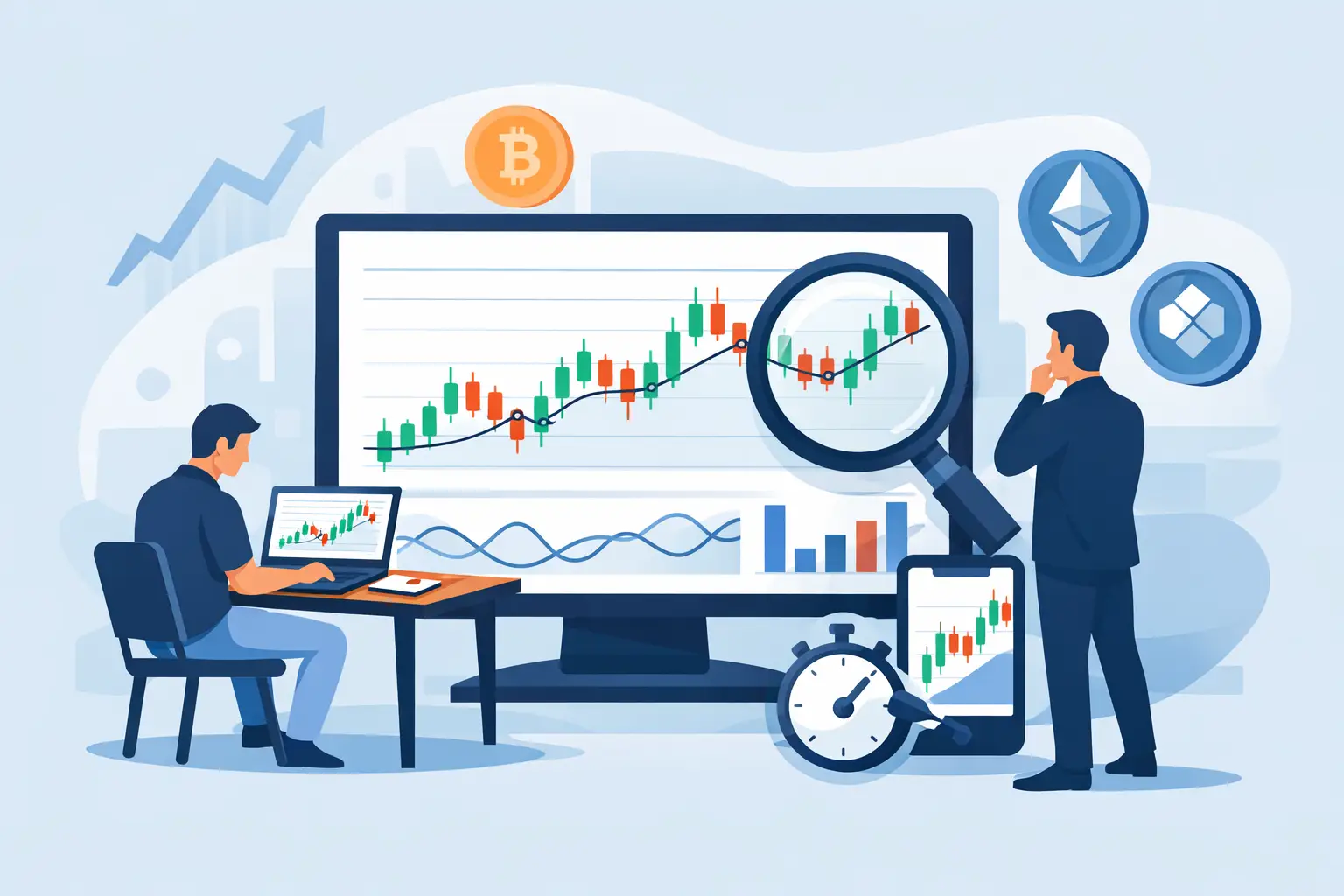
A crypto call can look brilliant after a token moves 40%. That does not prove the call was tradable, timely, or repeatable. To understand how to backtest crypto trade calls, you need to reconstruct what a follower could realistically have done at the moment the call was published, then measure the result under consistent rules.
The standard is simple: no hindsight, no selective screenshots, and no credit for vague commentary. A backtest should answer whether a source's calls created actionable opportunity after entries, exits, risk, fees, and timing are accounted for.
What qualifies as a crypto trade call?
Start by separating a trade call from market commentary. “Bitcoin looks strong” is an opinion. “Buy BTC between $62,000 and $63,000, invalidation below $60,500, target $66,000” is a testable trade idea.
Not every call will be this precise. Social media content often contains partial instructions, delayed edits, and conditional language. Your methodology must define what counts before reviewing results. Otherwise, you will unconsciously give favorable calls more benefit of the doubt than unfavorable ones.
A usable call generally needs an identifiable asset, a directional bias, and a timestamp. For a complete trade-level test, it should also provide or imply an entry range, a stop or invalidation level, and an exit target. If one of these is missing, record that fact instead of inventing a rule that improves the outcome.
For example, “long SOL here, target $180” may be eligible for directional tracking, but it is not a fully specified risk-managed trade. That distinction matters. An influencer can be right on direction while still publishing calls that cannot be executed responsibly.
Build rules before reviewing outcomes
The credibility of a backtest comes from the rules applied before you know whether the trade won or lost. Define a consistent protocol for every source and every platform.
First, choose the timestamp that represents public availability. A YouTube video should be measured from its publication time, not from the recording date. An X post should use its posted timestamp. A Telegram call should use the message time visible to members. If content was edited or deleted, preserve the original observable record where possible and document the limitation.
Next, set an entry convention. You might use the market price at publication, the first available candle close after publication, or the midpoint of a stated entry zone. Each approach has trade-offs. Market-price entry favors immediacy but may overstate fill quality in thin markets. A candle-close rule is easier to reproduce but may miss fast-moving entries. The important point is consistency.
Then define the exit convention. If a call includes a stop loss and take profit, the test is straightforward: determine which level was reached first. If the call provides multiple targets, specify whether the model exits fully at the first target, scales out, or tracks each target separately. Do not count every target as a full winning trade.
When no exit is stated, use a predetermined holding period, such as 24 hours, seven days, or 30 days. This does not turn an incomplete call into a high-quality setup. It simply creates a standardized way to measure directional performance. Report these trades separately from calls with explicit risk and reward parameters.
Use price data a real trader could access
A backtest is only as reliable as its market data. Use timestamped OHLCV data from a liquid, relevant venue whenever possible. For major assets, a large centralized exchange may provide a reasonable reference. For smaller tokens, price differences between decentralized exchanges and centralized exchanges can be material.
Match the data source to where the trade could realistically be executed. A call on a low-liquidity token may show a favorable chart price while buyers faced substantial slippage, a shallow order book, or no practical exit. Those conditions are not a footnote. They are part of the trade result.
For each call, capture the asset, trading pair, venue or price source, publication timestamp, entry timestamp, entry price, highest and lowest prices during the evaluation window, and exit price or status. Use a time zone consistently, preferably UTC, to avoid errors when comparing posts with exchange candles.
Also account for liquidity filters. A 60% gain in a microcap is not equally meaningful if the modeled position could not be entered or exited near the quoted price. Minimum volume, market capitalization, bid-ask spread, and available liquidity should shape which calls are eligible for a performance score.
Include fees, slippage, and position risk
Raw price change is not ROI. A call that gains 2% before fees and slippage may be flat or negative after execution costs. This is especially true for frequent trading, leveraged products, and low-liquidity altcoins.
Apply a fee assumption that fits the likely venue. Add a slippage assumption based on the asset's liquidity and the position size being modeled. Conservative assumptions are preferable to flattering ones. If the result depends on perfect fills, it is not a durable result.
Risk also needs a common denominator. Win rate alone can mislead because a strategy can win often while suffering occasional large losses. Track average gain, average loss, realized ROI, maximum drawdown, and the average risk-reward ratio when stops are available.
Consider two calls. Source A wins 70% of the time but averages a 1% gain and occasionally loses 12%. Source B wins 48% of the time but averages a 5% gain with a 2% defined loss. Source B may have the stronger expectancy despite the lower win rate. Performance needs context, not a single headline metric.
Measure the metrics that reveal repeatability
Once each call has been evaluated under the same rules, aggregate results by influencer, asset type, timeframe, and market regime. A useful scorecard should show more than total return.
Track the number of eligible calls alongside win rate and cumulative ROI. A 90% win rate across ten calls says far less than a 58% win rate across 300 calls. Sample size does not guarantee quality, but it determines how much confidence the data can support.
Measure expectancy per trade: the average amount gained or lost for each unit of risk. Include profit factor, which compares gross profits with gross losses, and maximum drawdown, which shows the severity of the path taken to reach a return. A high-return record with extreme drawdowns may not match an investor's risk tolerance.
Segmenting results is equally valuable. Some analysts may perform well on Bitcoin and Ether but poorly on small-cap rotation. Others may be effective during trending markets and unreliable during choppy conditions. A source's historical edge is rarely universal.
At My Crypto Monitor, this is the purpose of structured performance analysis: turning fragmented social content into comparable historical evidence. Backtested. Verified. Trusted. The goal is not to crown a permanent winner. It is to identify which sources have earned attention under transparent measurement.
Handle ambiguity without rewriting history
Ambiguous calls are where many influencer scorecards fail. A creator may post “taking profits,” “watching for a breakout,” or “this could run.” These statements can be useful context, but they should not be treated as precise trades unless the original content provides a testable instruction.
Create clear classifications such as actionable, partially actionable, commentary, and untestable. Keep untestable calls in the archive if they matter to the narrative, but exclude them from trade-performance calculations. Report the exclusion rate. A source that produces many vague calls should not receive the same confidence as one that consistently publishes defined setups.
The same discipline applies to deleted posts and follow-up messages. Do not allow a later post to retroactively define an entry or exit that was absent from the original call. Record updates as updates. A valid trade thesis can evolve, but the scorekeeping must preserve the sequence investors actually received.
Common backtesting errors to avoid
The fastest way to produce misleading results is to begin with winners and work backward. Avoid cherry-picking calls from a creator's feed, measuring entries before public publication, or ignoring calls that were quietly deleted.
Do not use the token's daily high as the assumed exit unless a stated target was actually reachable and executable. Do not treat a call as a win simply because price moved favorably at some point. If the source never provided an exit and the market reversed before a realistic close, the trade outcome is not a clean win.
Finally, do not confuse historical performance with a guarantee. Backtesting identifies evidence of past behavior under defined assumptions. It cannot eliminate changing market conditions, liquidity risk, or the possibility that a previously effective approach stops working.
A disciplined backtest does not tell you to follow every high-scoring voice. It tells you which voices deserve deeper research, what conditions have supported their calls, and where their record becomes less reliable. That is the difference between consuming crypto content and using it as evidence.
Not financial advice — read our risk disclosure.